
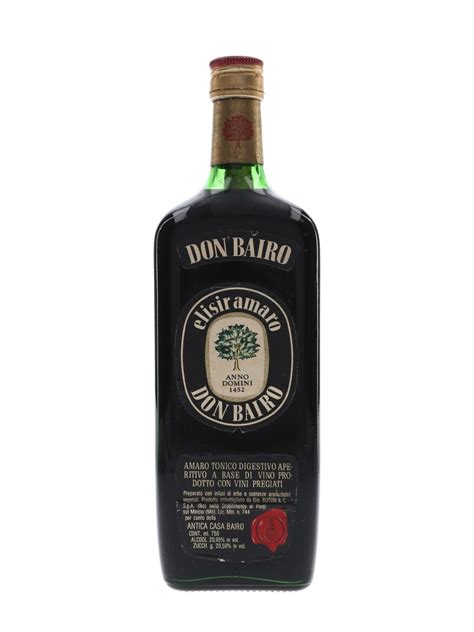
Ingredients
A dense herbal infusion in the Piedmontese ecclesiastical tradition — the kind of recipe passed from a parish herbalist into commercial production, leaning on roots, barks and warming spice rather than citrus.
- ✦Gentian root
- ✦Rhubarb root
- ✦Cinchona bark
- ✦Cinnamon
- ✦Cloves
- ✦Alpine herbs
History of the Brand
Don Bairo belongs to Italy's long line of clerical amari, where a priest's fortifying herbal tonic eventually reached a distillery and a label.
Piedmont produced more of these than anywhere else: the region's alpine flora and Turin's vermouth trade gave herbalists both raw material and a market.
The bottle stayed a local staple rather than a national brand, which is why it is far better known in Turin cafés than in export markets.
It is typically served the old way — a small glass, no ice, after a long Piedmontese lunch.
Tasting Characteristics
Clove, dried bark, cola-like root sweetness.
Bitter root and rhubarb over baking spice; medium sweetness holds it together.
Warm, peppery, lingering.
Flavor meter
How to serve it
- 01Neat at room temperature after dinner.
- 02Over ice with an orange twist.
- 03Split with rye whiskey in a Black Manhattan.
- 04Stirred into coffee, Piedmont-style.
Where to Get It
Largely Italian distribution; scarce abroad.
Piedmont enoteche
The most reliable place to find it.
Italian online shops
Ships within the EU more readily than to the US.
Specialist importers
Occasional parallel imports; check amaro-focused retailers.
Where to buy Amaro Don Bairo
We may earn a commission when you buy through these links, at no extra cost to you. See our affiliate disclosure.
Amaro Don Bairo FAQ
Why is it called Don Bairo?
+
'Don' is the Italian honorific for a priest — the amaro traces to a clerical herbal recipe, a common origin story in Piedmont.
Is it hard to find outside Italy?
+
Yes. It is mostly a domestic bottle; look for it in Piedmont or through amaro specialists.