
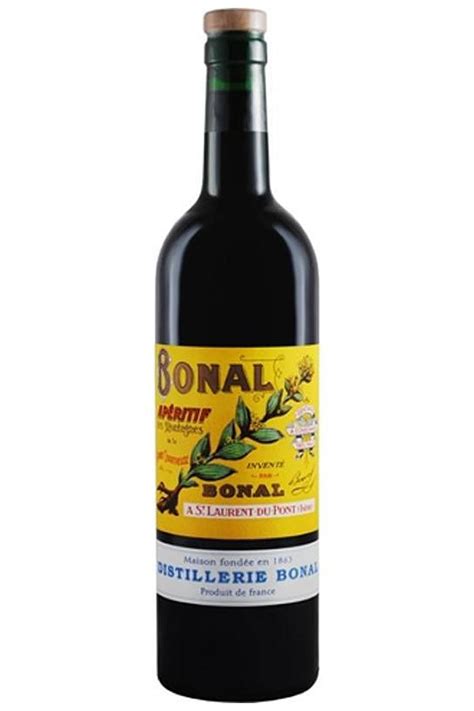
Ingredients
A mistelle and wine base infused with gentian root, cinchona bark and Grande Chartreuse herbs — a recipe originally written by a monk.
- ✦Yellow gentian root
- ✦Cinchona (quina) bark
- ✦Alpine herbs of the Grande Chartreuse
- ✦Mistelle grape must
History of the Brand
Frère Raphaël, a monk at the Grande Chartreuse, devised the formula in 1865 as a fortifying tonic.
Its advertising slogan — 'l'ami du foie', the friend of the liver — was later softened to 'l'ami des randonneurs', the hiker's friend.
Production has been carried out at Dolin in Chambéry, the historic vermouth house, for decades.
Bonal disappeared from the US for most of the twentieth century and returned in 2010, immediately adopted by cocktail bars as a vermouth alternative.
Tasting Characteristics
Prune, cocoa, gentian, dried herbs.
Grapey sweetness cut by gentian and quinine, with an Alpine herbal lift.
Medium-long, drying, faintly medicinal.
Flavor meter
How to serve it
- 01Chilled over ice with a lemon twist.
- 02Swapped for sweet vermouth in a Manhattan or Negroni.
- 03Bonal and tonic, long and low-proof.
- 04With soda and orange as an afternoon aperitif.
Where to Get It
Widely available in the US and Europe at a friendly price.
Specialty liquor stores
Filed with vermouths and quinquinas.
Online retailers
Consistently one of the best-value aperitifs on the shelf.
Cocktail bars
A common house substitute for sweet vermouth.
Where to buy Bonal Gentiane-Quina
We may earn a commission when you buy through these links, at no extra cost to you. See our affiliate disclosure.
Bonal Gentiane-Quina FAQ
Is Bonal a vermouth?
+
No — it is a quinquina: wine-based like vermouth, but built on gentian and cinchona rather than wormwood.
Can Bonal replace sweet vermouth?
+
Yes, in Manhattans, Negronis and Boulevardiers, adding more root bitterness and dark fruit.
Does Bonal need refrigeration?
+
Yes — it is wine-based and should live in the fridge once opened.