
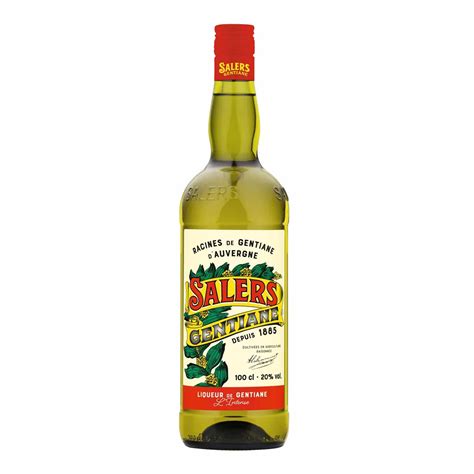
Ingredients
Fresh yellow gentian roots hand-dug at altitude in the Cantal, macerated in neutral spirit and lightly sweetened — a far leaner, drier build than most gentian aperitifs.
- ✦Fresh Gentiana lutea root
- ✦Neutral spirit
- ✦Mountain water
- ✦Cane sugar
History of the Brand
Alfred Labounoux launched Salers in 1885 in the village of Turlande, making it the oldest gentian aperitif still in production.
The gentian is still pulled by hand from volcanic pasture with a two-pronged fork; a mature root takes fifteen to twenty years underground.
Salers won its first medals at turn-of-the-century expositions and became the Auvergne's café pour, drunk long with soda.
American bartenders adopted it in the 2010s as the drier, greener alternative to Suze in White Negronis and low-ABV highballs.
Tasting Characteristics
Damp earth, gentian, hay, faint lemon.
Much less sweet than its rivals — pure gentian bitterness with a saline mineral edge.
Long, clean, austere.
Flavor meter
How to serve it
- 01Over ice with soda and a lemon wedge, the Auvergne way.
- 02In a White Negroni for a drier, more bracing version.
- 03With dry white wine and sparkling water as a summer aperitif.
- 04A small pour neat before a rich mountain meal.
Where to Get It
Widely imported to the US in 1L bottles; standard stock in France.
Specialty liquor stores
Look near Suze and other gentian aperitifs.
Online retailers
Usually the best price; the 1L format is the norm.
French cafés and grocers
A regional staple across the Massif Central.
Where to buy Salers Gentiane
We may earn a commission when you buy through these links, at no extra cost to you. See our affiliate disclosure.
Salers Gentiane FAQ
How is Salers different from Suze?
+
Salers is drier and more sharply rooty; Suze is sweeter and more floral.
What is Salers made from?
+
Fresh yellow gentian root hand-dug in the Cantal, macerated in spirit and lightly sweetened, at 16% ABV.
How do the French drink Salers?
+
Long over ice with soda water and a squeeze of lemon, as a pre-dinner aperitif.