
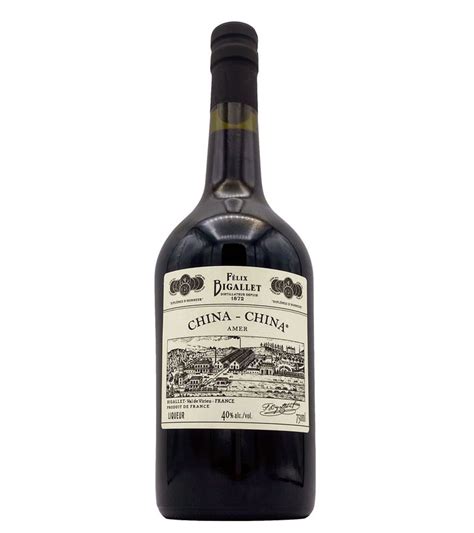
Ingredients
Sweet and bitter orange peels distilled and macerated, blended with cinchona bark and gentian for the amer backbone.
- ✦Bitter orange peel
- ✦Sweet orange peel
- ✦Cinchona bark
- ✦Gentian root
- ✦Cardamom
- ✦Cinnamon
- ✦Clove
- ✦Caramel
History of the Brand
Félix Bigallet founded his liqueur house in 1872 in the Bugey, between Lyon and the Alps.
China-China takes its name from the cinchona bark ('china') that supplies its quinine bitterness.
As Amer Picon was reformulated downward in strength and pulled from the US market, bartenders adopted China-China as the working substitute in Picon drinks.
It stayed a specialist bottle in France while becoming a cocktail-bar fixture in the United States.
Tasting Characteristics
Orange marmalade, clove and a hint of cola spice.
Rich orange peel and caramel up front, then a firm quinine and gentian bitterness underneath.
Dry, orange-bitter and persistent.
Flavor meter
How to serve it
- 01In place of Amer Picon in a Brooklyn or a Liberal.
- 02With beer as a Picon Bière.
- 03Over ice with soda and an orange slice.
- 04Neat in a small glass after dinner.
Where to Get It
Widely available in the United States and France; a standard cocktail-bar bottle.
Cocktail bottle shops
Shelved with amari and French bitters, $35–$45.
Online spirits retailers
Search 'Bigallet China-China'.
French grocers
Sold across the Rhône-Alpes region.
Where to buy Bigallet China-China Amer
We may earn a commission when you buy through these links, at no extra cost to you. See our affiliate disclosure.
Bigallet China-China Amer FAQ
Is China-China a good Amer Picon substitute?
+
It is the most common one. Use it one-for-one in Brooklyn and Liberal builds; it is stronger and more bitter than modern Picon.
What does 'china' mean here?
+
It refers to cinchona bark, the quinine-bearing bark that gives the liqueur its bitter backbone.