Brooklyn, Los Angeles, Denver, the Bay — a generation of American distillers is making bitter liqueur on Italian bones. Five bottles worth your shelf, and an argument about whether any of it is allowed.
August 17, 2026 · 9 min read · Robert Parker Cross
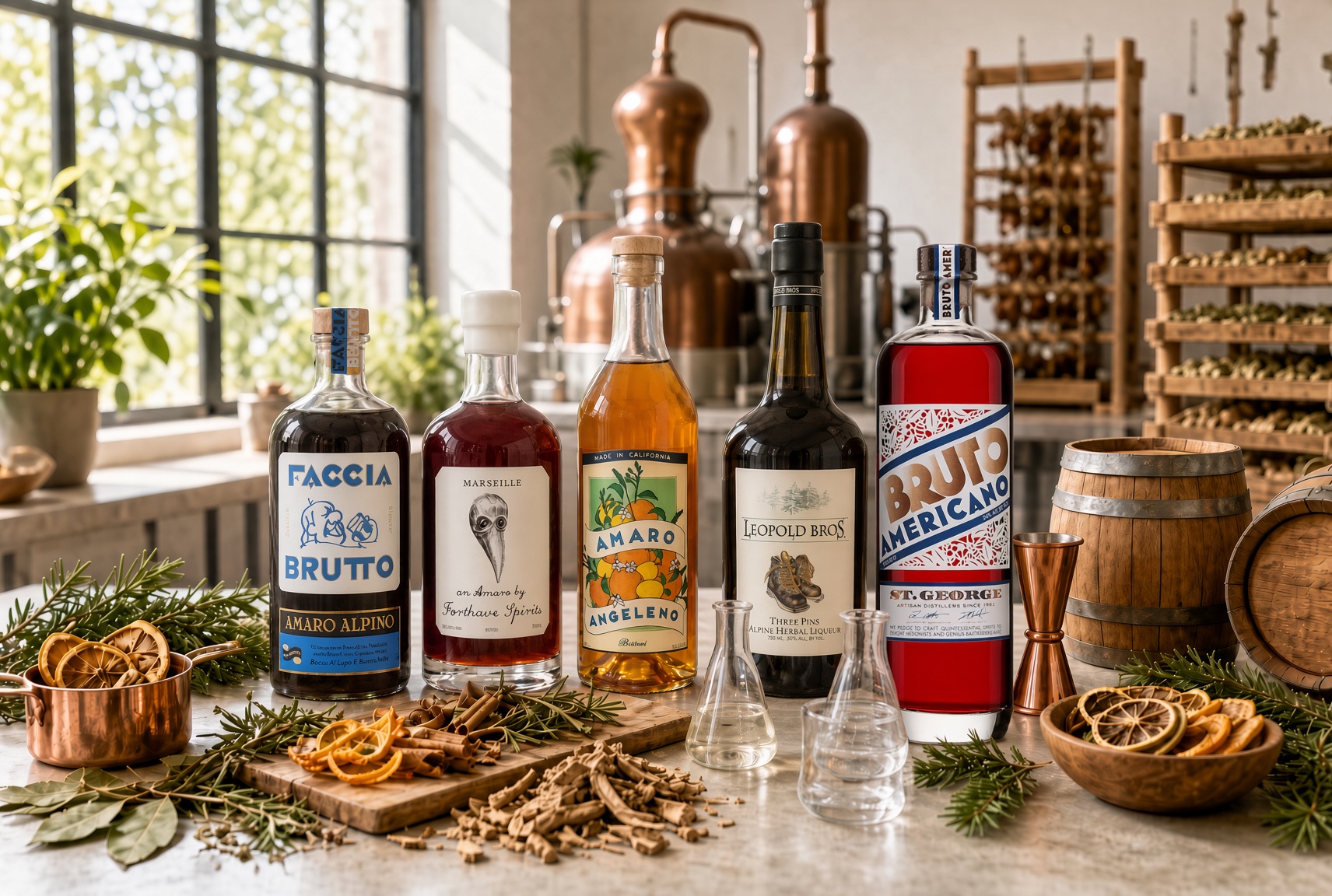
Amaro is an Italian idea. Monks, apothecaries, family recipes locked in a safe in Milan or Sicily, a category built over centuries by people who inherited it. So when a distiller in Brooklyn or Los Angeles bottles something and calls it amaro, the purist reflex kicks in immediately: is that allowed?
The short answer is yes, and the longer answer is more interesting. Amaro has never been a protected designation the way Champagne or Chianti is. It is a method — bitter botanicals macerated in a neutral or grape base, sweetened, rested — and a sensibility. Italy did not patent bitterness. It perfected it.
What is happening in the United States right now is genuinely the most interesting thing in bitter liqueur since the postwar Italian brands went national. Here is where it is made, who is making it, how it actually tastes, five bottles worth buying — and an honest reckoning with the sacrilege question. If you are new to the category at all, start with What Is Amaro, then come back.
There is no single American amaro region, which is exactly the point. The bottles cluster where craft distilling clustered: Brooklyn and the Hudson Valley, the Bay Area, Los Angeles, Portland and Seattle, Denver and the Colorado Front Range, and a scattering of small operations through the Midwest and the Southeast.
Geography shows up in the glass. Colorado distillers reach for spruce tips, mountain sage and alpine botanicals that read as a Rockies answer to Braulio. California producers lean on the citrus that grows in their backyards — Seville orange, grapefruit, bay laurel. Brooklyn tends toward the archival: distillers rebuilding a 19th-century Italian or French profile from books and instinct.
The regulatory reality also shapes the category. In the United States most of these bottles are labeled 'liqueur' or 'bitter liqueur' with 'amaro' as a brand or style word, because the TTB has no amaro category. That paperwork detail is why you will sometimes see 'amaro-style' on a back panel from a producer being careful.
Italy did not patent bitterness. It perfected it.
The people making American amaro are mostly not legacy distillers. They are bartenders who got tired of waiting for allocations, gin distillers with a botanical library already on the shelf, and a few second-career obsessives who fell down the same rabbit hole most of us did.
The timing is not an accident. The cocktail revival of the 2000s put Fernet-Branca, Cynar and Averna behind every serious bar in the country. Bartenders learned the vocabulary, then started asking the obvious next question: what would this taste like made here, with what grows here?
There is also a supply-chain answer. Some historic Italian and French bottles are hard to get in the States, or vanished entirely. When a bartender cannot buy the bottle a spec calls for, the enterprising ones eventually make it.
Better than the skeptics expect and more uneven than the boosters admit. The best American amari are precise, bracing and confident. The weakest ones share one flaw: too much sugar and too little bitterness, an attempt to make the category friendly before it has earned the right to be.
There are also stylistic tells. Many American bottles run higher in proof — Faccia Brutto's Alpino sits around 35% — though that is a tendency rather than a rule: St. George's Bruto Americano is 24%, the same band as Campari. More consistent is the citrus, and the willingness to use unusual botanicals — cacao husk, hops, coffee, yerba mate, hyssop, spruce. Wood is used more heavily too, borrowing from a whiskey culture that Italy simply does not have.
The result is that American amaro often behaves differently in a cocktail. Where a soft Italian bottle recedes, an American one insists. If you are swapping, match the ABV band first — our amaro substitution guide walks through how to do it without wrecking a spec.
Where a soft Italian bottle recedes, an American one insists.
**1. Faccia Brutto Amaro Alpino — Brooklyn, New York.** Patrick Miller's Bedford-Stuyvesant operation is the purest expression of the archival impulse: Italian styles rebuilt from scratch, small batch, no shortcuts. Miller is a liqueur producer rather than a pot-still house — botanicals macerated in neutral grain spirit, then rested in barrel. The Alpino is a mountain-herb amaro — spruce, rhubarb, eucalyptus, chicory and gentian — dry, cold and disciplined. If you love Braulio, this is the American bottle to buy first.
**2. Forthave Spirits Marseille Amaro — Brooklyn, New York.** Named for the plague-doctor legend on the label, Forthave's Marseille is the most apothecary-minded bottle in American bitters: saffron, myrrh, angelica, a bright herbal top and a long medicinal finish. It drinks like an elisir from a very good pharmacy. Superb in a stirred whiskey drink.
**3. Amaro Angeleno — Los Angeles, California.** The most unapologetically Californian bottle of the five: gentian and wormwood underneath, but the top note is Southern California citrus — grapefruit peel and orange. Lower proof, brighter, and the easiest of these to hand to someone who thinks they hate bitter. Spritz it.
**4. St. George Bruto Americano — Alameda, California.** Strictly speaking this one is an aperitivo, not a digestif amaro; including it here is a style argument rather than a category fact. St. George have been making excellent oddball spirits since 1982, and Bruto Americano is their red bitter at 24%: Seville orange, gentian, and West Coast botanicals including balsam fir and cascara sagrada (California buckthorn), colored naturally with cochineal rather than dye. It is the most credible domestic answer to Campari in a Negroni, and it is drier and earthier than the original.
**5. Leopold Bros Three Pins Alpine Herbal Liqueur — Denver, Colorado.** Todd Leopold's Three Pins takes the alpine template — twenty-plus herbs, gentian, spruce — and grounds it in Rocky Mountain botanicals. It is sweeter and rounder than Faccia Brutto's Alpino, and it makes a superb winter highball or a substitution in anything calling for a soft alpine amaro.
None of these is trying to be a replica. That is the strongest argument in their favor.
**Sugar.** Plenty of American bottles read drier than Averna or Montenegro — but it is a tendency, not a rule, and some U.S. bottles are sweeter than Braulio or Fernet. Where a mainstream Italian bottling rounds the bitterness off with cane sugar, many American versions leave the gentian and wormwood exposed. Bruto Americano beside Campari is the clearest demonstration: the same red-bitter role, noticeably less candy.
**Botanical accent.** Italian recipes lean on Mediterranean citrus, rhubarb, cinchona and Alpine herbs. American recipes keep that spine and add what grows locally — spruce, balsam fir, hops, cascara sagrada, Rocky Mountain conifer. The family resemblance stays; the accent changes.
**Wood and proof.** American producers come out of a whiskey culture, so barrel time is more common and the proof often runs higher — with exceptions like Bruto at 24%. Where the strength is there, it makes American bottles louder in a stirred drink and more assertive when you split a base spirit.
**Provenance.** Italian amari usually carry a house history measured in generations; the American bottles carry a founder, a decade and a lot of experimentation. Neither guarantees quality. Pour them side by side — an Amaro Alpino next to Braulio is the fastest education available — and judge on the glass.
The case for sacrilege goes like this: amaro is inseparable from place. The Ligurian hillside, the Sicilian orchard, the family that has made the same thing for five generations. Strip out the place and you have a flavor exercise — a very good one, maybe, but a costume.
It is not a stupid argument. There is real cultural weight in these recipes, and it deserves respect rather than a marketing appropriation of the word 'amaro' to sell a sweetened bitters shot.
But the argument does not survive contact with the actual history. Amaro has always been a moving target. Fernet-Branca was invented by an entrepreneur in 1845 and sold as medicine. Cynar is a 1952 product built on artichokes, and the traditionalists of the day hated it. Half the botanicals in a 'traditional' Italian recipe — cinchona from Peru, Chinese rhubarb, cardamom from India — came off a boat. The category was globalized from birth. We tell that whole story in the History of Amaro.
What we should insist on is honesty, not geography. Say what is in the bottle. Do not fake a family crest or invent a monastery. Credit the tradition you are borrowing. Do those things and the passport of the distiller is beside the point.
Insist on honesty, not geography.
Every one of these producers took a category most Americans could not pronounce ten years ago and bet a business on it. They read the old texts, sourced gentian root nobody was importing, and made something bitter in a market that spent fifty years asking for sweet.
That is not disrespect. That is the highest compliment a tradition can be paid: someone in another country cared enough to learn it, then risked their own money continuing it.
There is no fixed number of shelves in the world. An excellent Brooklyn amaro does not take anything away from Sicily — it sends people looking for Sicily. Every bartender who pours Bruto Americano in a Negroni has a customer who eventually asks what the original tastes like.
Buy the Italian bottles. Buy the American ones too. Pour them side by side and pay attention to what each does that the other cannot. There is enough space for all of us.
An excellent Brooklyn amaro does not take anything away from Sicily — it sends people looking for Sicily.
American amaro is a bitter herbal liqueur made in the United States in the Italian amaro idiom: a neutral or grape spirit base infused with bittering roots and barks, aromatic herbs and citrus, then sweetened and usually rested. The category has no legal definition, so the style ranges from alpine and minty to dark, root-driven and cola-like.
Yes, in every sense that matters in the glass. Amaro has never been a protected designation, and Italian producers have always built recipes around imported botanicals. American distillers follow the same method with local wormwood, spruce, hops and citrus, which makes their bottles a continuation of the tradition rather than a knockoff.
Faccia Brutto Amaro Alpino from Bedford-Stuyvesant, Brooklyn; St. George Bruto Americano from Alameda, California; Leopold Bros Three Pins from Denver; Forthave Spirits Marseille Amaro from Brooklyn; and Amaro Angeleno from Los Angeles. Between them you cover alpine, bitter aperitivo, citrus and gentian-forward styles.
American amari tend to read brighter and more aromatic, with louder citrus, conifer and hop notes and often a touch less sugar than mainstream Italian bottlings. Pour one beside its Italian reference — Amaro Alpino next to Braulio, Bruto Americano next to Campari — and the family resemblance is obvious even when the accent is not.
Usually yes. Alpine-style American amari swap cleanly into a Braulio or Fernet drink, and bitter aperitivo styles work in a Negroni or Spritz. Start at a one-to-one pour, taste, and dial back the sweet vermouth if the bottle runs drier than the original. Our substitution guide lists bottle-by-bottle swaps.
Craft-focused bottle shops, distillery tasting rooms and most state-legal online spirits retailers carry these labels. Smaller producers like Faccia Brutto and Forthave often ship regionally, so the distillery's own site is worth checking before a national retailer.
Enjoyed this? Send it around.
Post to X