Italians have poured a bitter digestivo after heavy meals for centuries. Here is where the belief comes from, what the clinical studies actually measured, and why the glass may feel better than it works.
October 14, 2026 · 10 min read · Robert Cross
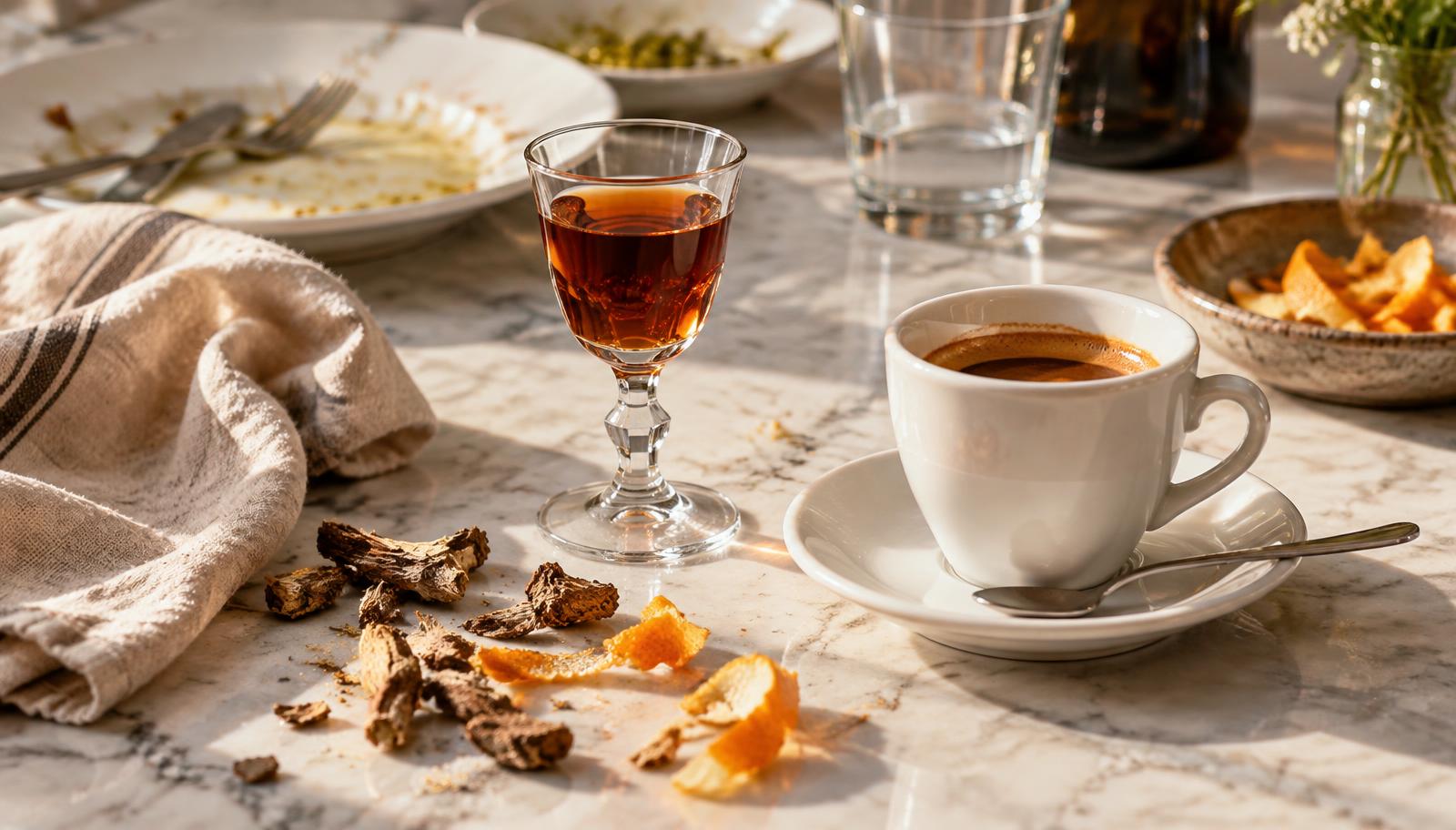
Order a heavy plate of pasta in Italy, finish it, and there is a good chance someone will suggest an amaro 'to help with digestion.' The word for this after-dinner pour, digestivo, carries the claim in its name. Plenty of American bartenders repeat it too.
So does amaro help digestion? The honest answer has two parts. The idea that bitter plants act on the stomach is old, and it has a real scientific basis worth taking seriously. But the handful of controlled human studies that test bitterness and after-dinner alcohol mostly point the other way: they slow the stomach down. This piece follows the belief from monastery infirmaries to modern labs, and ends with what you can reasonably expect from the glass.
Nothing here is medical advice. If you have reflux, ulcers or another digestive condition, talk to a doctor, not a bartender.
Every amaro descends from herbal medicine. Long before anyone bottled Averna or Fernet-Branca, physicians across the Mediterranean prescribed bitter roots and barks for the stomach. At the medieval medical school of Salerno, south of Naples, doctors collected Greek, Roman and Arab remedies into practical texts, and bitterness featured heavily in them.
The reasoning belonged to humoral medicine, the dominant theory for well over a thousand years. Illness was understood as an imbalance of the body's fluids, and bitter, 'warming' plants were thought to rouse a cold, sluggish stomach. Gentian root, wormwood, rhubarb and, later, cinchona bark were the workhorses. Alcohol solved a practical problem: it pulled more out of those plants than water could, and it kept the remedy from spoiling.
Monasteries, with their physic gardens and infirmaries, became the laboratories. Many amaro brands still tell a monastic origin story, and while some of those stories are tidied-up brand tradition, the broad picture is accurate. The full arc is in our history of amaro.
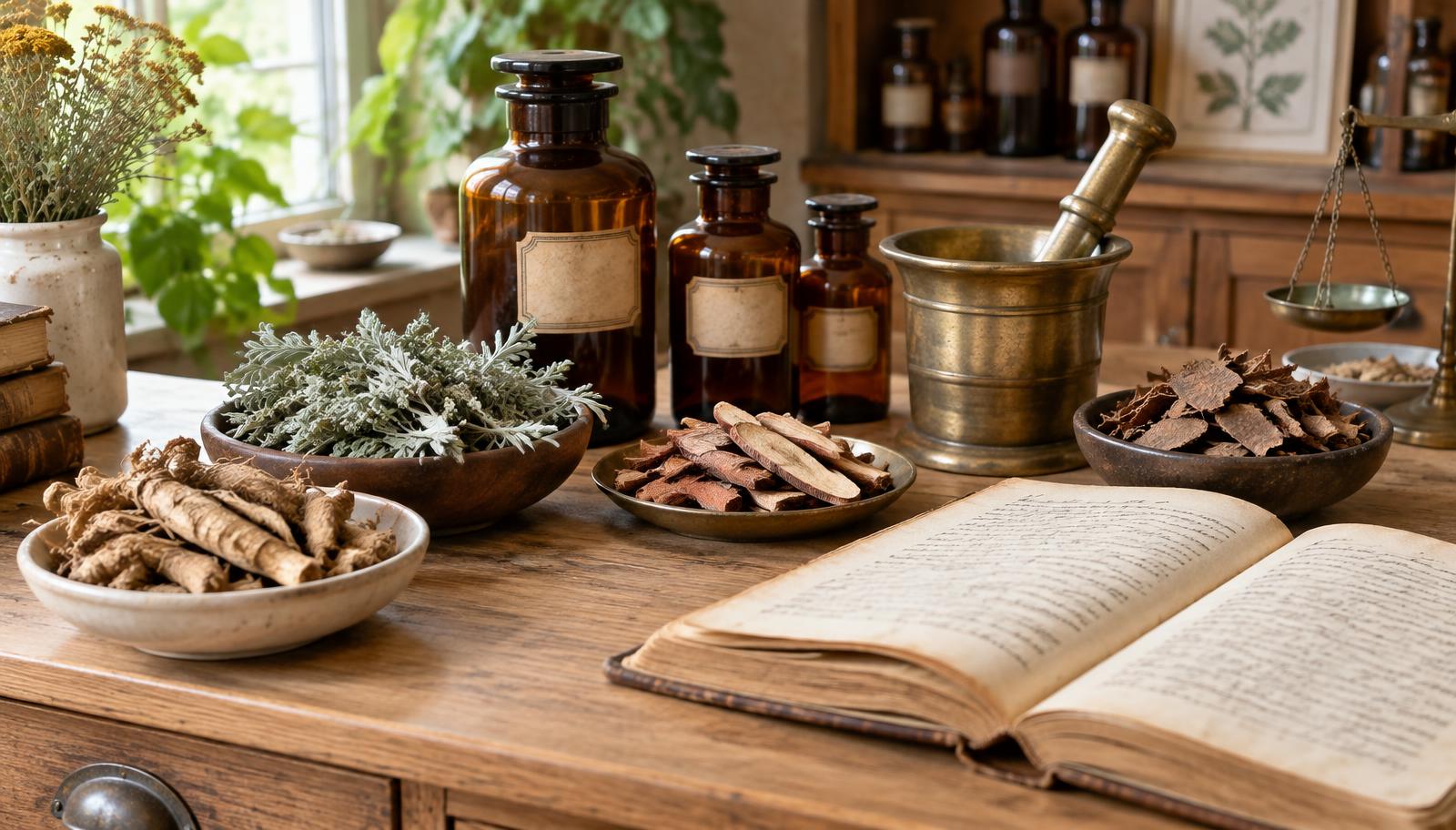
Between the 16th and 18th centuries, the speziale, an Italian apothecary who was part pharmacist and part distiller, sold proprietary bitter elixirs by the small bottle. Venice's spice trade brought in rhubarb root from China and cinchona from South America, and regional styles followed whatever grew nearby.
The 19th century turned medicine into a product. Cheaper sugar made the tonics pleasant to drink, and pharmacists became brand founders: Ramazzotti in Milan in 1815, Fernet-Branca in Milan in 1845, Averna in Sicily in 1868, Montenegro in Bologna in 1885. Their advertising leaned on health. Fernet-Branca was promoted in its early decades as a remedy for stomach complaints and even cholera, which is best read as period advertising rather than a medical record. Branca's own modern marketing jokes about it.
By the 20th century the medical claim had softened into a habit. The after-dinner digestivo became a social ritual of Sunday lunches and restaurant tables, and the belief that it 'settles the stomach' simply came along with the bottle. For how that label differs from the pre-dinner aperitivo, see amaro vs. digestivo vs. aperitivo.
Amaro moved from the infirmary to the dinner table, and the health claim came along with the bottle.
The old idea is not foolish. Humans detect bitterness through a family of taste receptors, and researchers have found related bitter receptors on cells lining the stomach and intestines, not only on the tongue. That discovery made the notion that bitter compounds 'talk to' the digestive system biologically plausible, and it has drawn serious research interest in recent years.
Herbalists have long described a reflex in which tasting something bitter primes the body for food, increasing saliva, stomach secretions and bile flow. That is the traditional theory behind bitters taken before or after a meal.
The problem is translation. A 2021 review in the journal Nutrients by Rezaie, Bitarafan, Horowitz and Feinle-Bisset at the University of Adelaide asked exactly that question: do the effects of bitter substances seen in cells and animals hold up in people? Their answer was cautious. Human results were limited and inconsistent, and the studies used isolated bitter compounds and doses that look nothing like a glass of amaro.
If bitterness helped digestion, you might expect it to speed the stomach along. In a 2005 study in the European Journal of Gastroenterology & Hepatology, Wicks, Wright, Rayment and Spiller at the University of Nottingham had sixteen healthy women chew and spit out either a bitter-tasting or a pleasantly flavored bar after a liquid meal. With the bitter bar, the stomach took noticeably longer to empty halfway: about 24.7 minutes versus 17.2. The authors concluded that an unpleasant bitter taste delays gastric emptying.
A related line of research explains why. In a 2011 paper titled 'Bitter taste induces nausea' in Current Biology, researchers at the Monell Chemical Senses Center reported that strongly bitter tastes can trigger nausea and disrupt normal stomach rhythms. That makes evolutionary sense: most plant toxins taste bitter, and slowing down or rejecting a suspect meal is protective.
Neither study used amaro, and both used tastes chosen to be unpleasant. A sweetened Sicilian amaro is not a lab bitter. But they undercut the simple story that bitterness reliably 'gets things moving.'
The strongest evidence on the digestif ritual comes from Switzerland, and it concerns alcohol rather than bitterness. Published in the BMJ in 2010, a randomized crossover trial by Heinrich, Fox and colleagues at University Hospital Zurich tested the local belief that wine and a shot of schnapps help a rich cheese fondue go down.
Twenty healthy adults ate the same fondue with either white wine or black tea, followed by either a 20 ml shot of cherry schnapps or water. Measured by a breath test, the stomach emptied significantly faster with tea and water than with wine and schnapps, and the more alcohol people drank, the slower it went. Interestingly, the alcohol did not make anyone feel worse: dyspeptic symptoms were about the same either way.
Amaro typically runs from about 16% to 40% alcohol. The Zurich study suggests that a strong after-dinner pour slows the stomach rather than speeding it up, even if it doesn't make you feel any worse.
Gastric emptying after the fondue was slower with wine and schnapps than with tea, and the more alcohol people drank, the slower it got.
None of this means the people who swear by an after-dinner amaro are imagining things. Several plausible reasons explain why the glass feels helpful:
Sugar and warmth. Most amari are sweetened, and a small, sweet, warming sip after a meal is genuinely comforting. Alcohol is a mild relaxant, and 'feeling relaxed' is easily read as 'feeling digested.'
Aromatics. Mint, citrus peel, chamomile and anise, common amaro botanicals, are pleasant and refreshing after heavy food. Some of these plants are studied in concentrated medicinal forms, but the dose in a 1.5-ounce pour is small and uncontrolled, so the evidence for those preparations should not be borrowed for a liqueur.
Ritual and pace. The digestivo marks the end of a meal. You stop eating, sit back, and talk. Slowing down after a big meal may do more for comfort than anything in the bottle.
Expectation. If a grandmother, a waiter and a label all say the drink helps, it is easy to feel that it does.
No good clinical evidence shows that drinking amaro speeds or improves digestion. The bitter-receptor science is real and interesting, but it has not been shown to translate into a benefit from a glass of liqueur. The best controlled studies on bitter taste and on after-dinner alcohol both found the stomach emptying more slowly, not faster.
What amaro clearly does is close a meal well: a moment of warmth, sweetness and bitterness that makes a heavy dinner feel finished. That is reason enough to pour one. Just pour it for pleasure, not as medicine, and if digestion is a real problem, see a doctor.
If you want to explore the bitter side of the category, start with our first five bottles, or read how amaro is made to see what is actually in the glass.
Wicks D, Wright J, Rayment P, Spiller R. Impact of bitter taste on gastric motility. European Journal of Gastroenterology & Hepatology, 2005.
Peyrot des Gachons C, Beauchamp GK, Stern RM, Koch KL, Breslin PAS. Bitter taste induces nausea. Current Biology, 2011.
Heinrich H, Goetze O, Menne D, Iten PX, Fruehauf H, Vavricka SR, Schwizer W, Fried M, Fox M. Effect on gastric function and symptoms of drinking wine, black tea, or schnapps with a Swiss cheese fondue: randomised controlled crossover trial. BMJ 2010;341:c6731. Read the study.
Rezaie P, Bitarafan V, Horowitz M, Feinle-Bisset C. Effects of Bitter Substances on GI Function, Energy Intake and Glycaemia — Do Preclinical Findings Translate to Outcomes in Humans? Nutrients, 2021;13(4):1317. Read the review.
There is no good clinical evidence that it does. Controlled studies found that bitter taste and after-dinner alcohol tend to slow how quickly the stomach empties. Many people still find an amaro comforting after a meal, likely because of its sweetness, aromatics, mild relaxing effect and the ritual itself.
Amaro descends from bitter herbal medicines that Italian apothecaries and monasteries prescribed for the stomach. When those tonics became commercial liqueurs in the 1800s, the after-dinner digestivo habit and its health reputation came with them.
Fernet-Branca was advertised as a stomach remedy in the 19th century, but there is no clinical evidence that it settles an upset stomach. It is a 39% ABV spirit, and alcohol can worsen reflux and some stomach conditions.
Bitter taste receptors exist in the gut, which makes an effect plausible, but a 2021 review in Nutrients found the human evidence limited and inconsistent. The best-known taste study found that an unpleasant bitter taste delayed stomach emptying.
Mostly out of tradition. The digestivo marks the end of a meal, often alongside an espresso, and the habit dates to when bitter tonics were sold as stomach medicine.
Enjoyed this? Send it around.
Post to X